Introduction
In the early days of developing the pick-and-place, the challenge was not only moving parts around quickly, but also knowing exactly where the carriage was at any given moment. Closing that positioning loop usually means adding expensive encoders or complex feedback systems. But for a first round of experiments, the search was for something radically simpler.
Mouse sensor concept
One of the most promising ideas came from an unexpected place: the humble mouse sensor. This tiny CMOS device, originally designed to track motion across a desk, looked almost perfect for the job. It combines a 32×32 pixel array with a dedicated lens, and streams motion data over SPI at 2 MHz. On paper, it offered a resolution of 17,904 counts per inch with a fixed working distance of 2.4 mm from the lens to the surface. For a system that needed to watch a flat carriage surface and provide direct position feedback, the fit seemed natural.
The real draw was accuracy. The datasheet claimed a repeated error of just 0.15% over 25 mm travel, which translates to roughly ±37.5 µm. For a lightweight optical chip, that looked compelling enough to test.
Test setup and methodology
To check this in practice, a simple rig was built using igus linear components: a spring-loaded rail and a zero-backlash lead screw to ensure smooth travel. To measure repeatability, an old but reliable dial gauge was pressed into service.
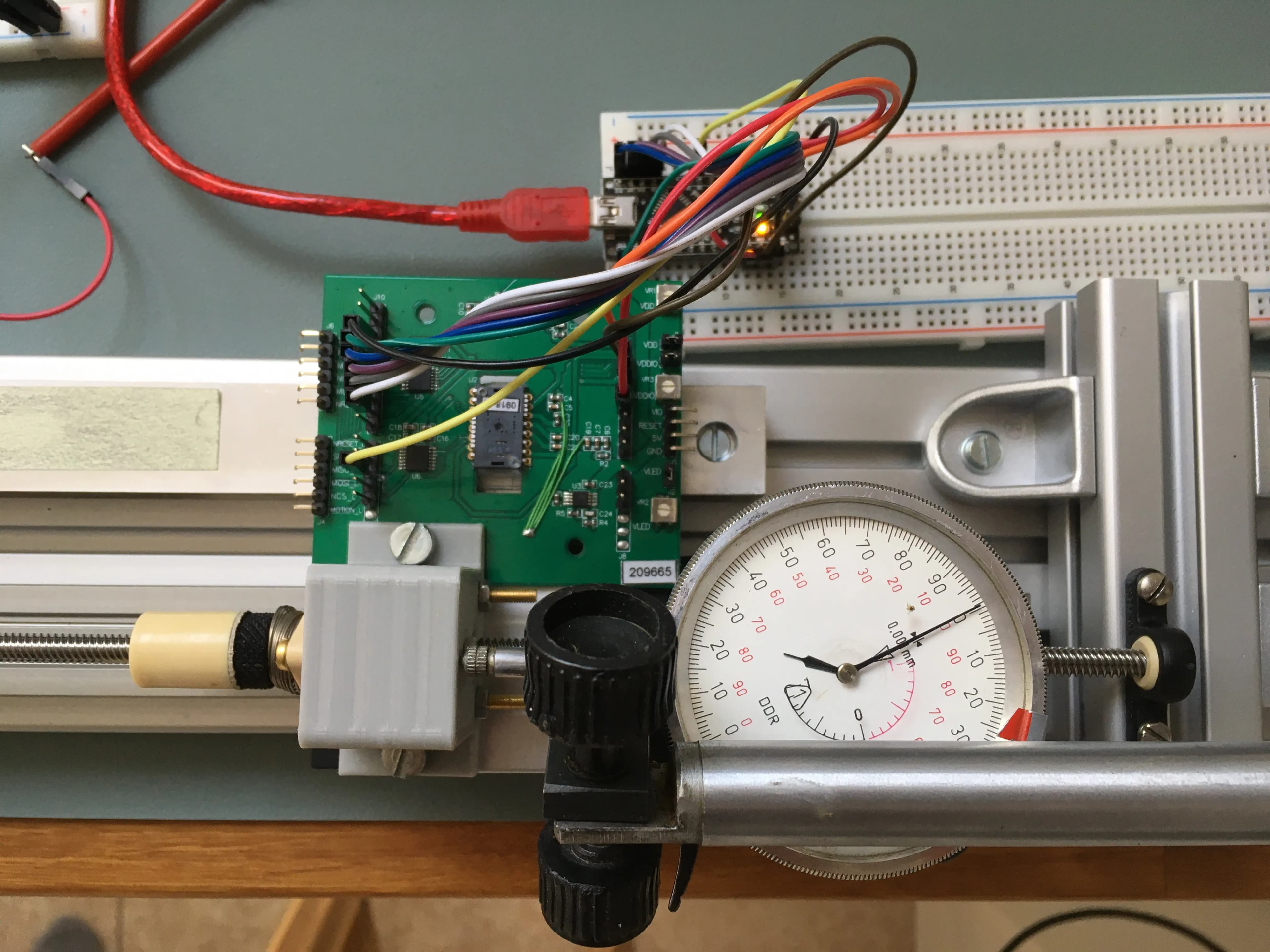
The mouse sensor's DSP handled the heavy lifting, turning raw images into motion data, though it was always a bit of a mystery how exactly those internal algorithms worked. Interestingly, the evaluation board even allowed extracting full image frames from the chip.
Surface testing and optimization
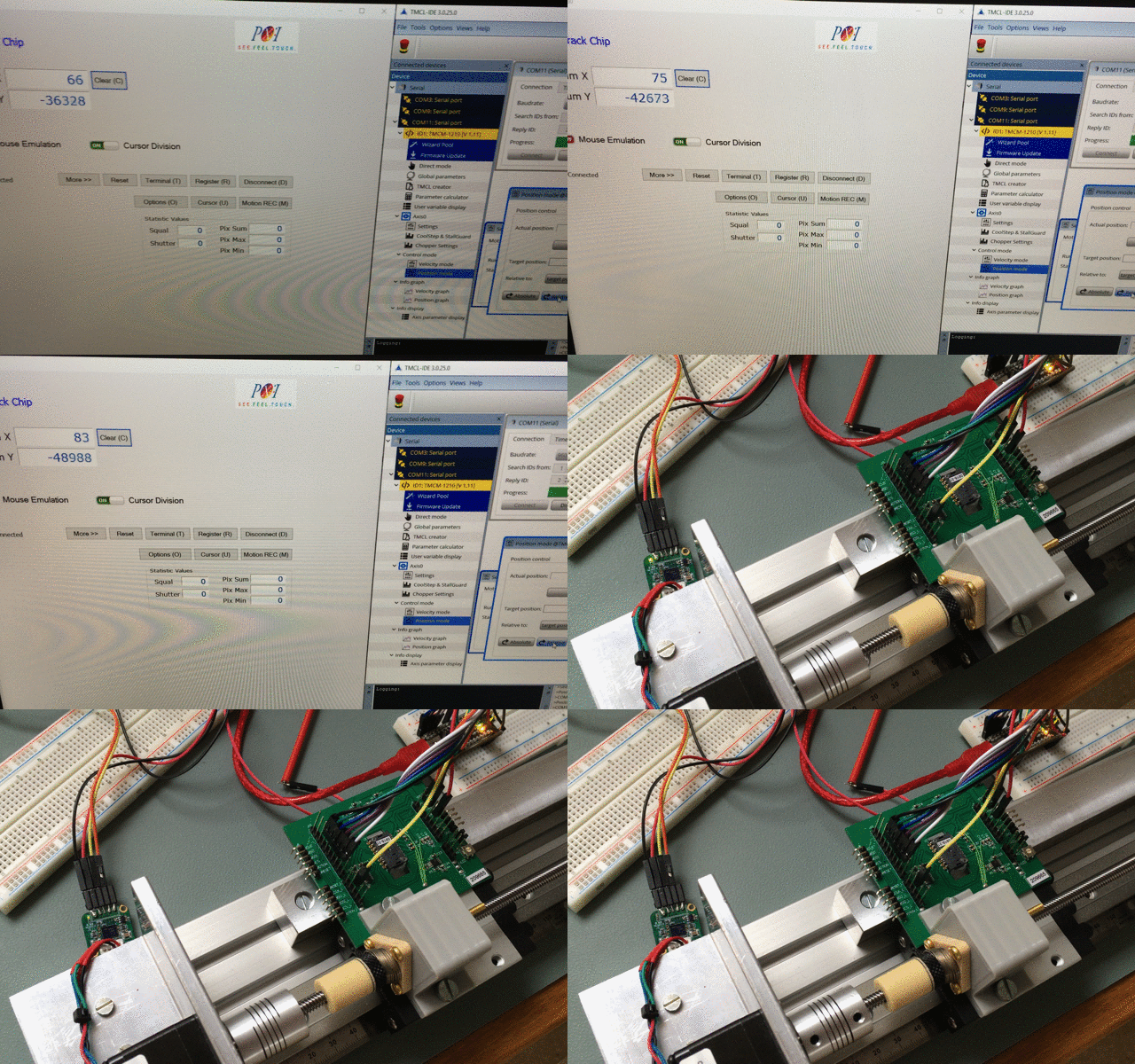
The first trials were about seeing if different surfaces and materials might make the sensor more reliable. Roughness, reflectivity, even color, all were tried in the hope of coaxing out a repeatable pattern for the DSP to lock onto.
Results and conclusion
In practice, the results simply confirmed the datasheet: the error accumulated exactly as expected. While the concept didn't progress beyond the prototype stage, the exercise proved that an optical sensor could indeed serve as a positioning reference. With about 40 µm error over 25 cm travel, it wasn't quite enough for the target of 08004 parts (just 125 µm on the short side), but it was close.
For a short moment, the pick-and-place carriage really could have navigated its world the same way a computer mouse does, sliding across a flat surface, watching every tiny movement in real time.