Introduction
Today, I'm excited to share the progress of my piezo drive experiment. My goal was to verify if the mechanics for the piezo drive are functioning correctly. This experiment is a crucial step in my journey towards developing a precise micro-dosing system for solder paste.
Experimental setup
For this experiment, I used a PDu100B piezo driver connected to a 1919 TDK piezo actuator. I set up the PDu100B S1 for unipolar 100V operation with specific switch configurations. The input signal was applied to Vup with an input range of ½ Vs ±1.8V, which I later optimized to 2.5V ±1.65V to avoid early clipping.
To test the system, I prepared a syringe that I could fill with various test liquids, including distilled water, isopropyl alcohol, and solder paste. For fine adjustments of the distance between the needle and the nozzle, Thorlabs set screw with a 200μm thread spacing is used, which would allow me to make precise movements when setting the distance.
Initial tests with distilled water
I decided to begin with distilled water as my test liquid. This choice was practical because water wouldn't dry out quickly, allowing me to easily spot any leaks in the system. To my surprise, the system worked almost immediately! As I started the experiment, I found that adjusting the needle position was crucial. I carefully tweaked the position until I noticed a distinct change in the sound produced by the system. Then, I slightly backed off the needle, perhaps by about 90°, until the sound returned to normal. This process helped me find the optimal position for the needle. With the Thorlabs set screws, I can make very precise adjustments. A quarter turn of these screws equates to a 50μm movement, which is exactly the level of precision I am aiming for in this experiment. Once I had the positioning right, I observed that the water was being visibly dosed in squirts. This was an excellent sign, indicating that the needle was indeed being pushed by the actuator as intended. Interestingly, I noticed that the pressure in the syringe played a significant role in the dosing process. Higher pressure seemed to result in more liquid being expelled, which made sense intuitively. However, I also observed that if the needle was positioned too close to the nozzle, water would leak through. At first, this looked like a malfunction, but upon reflection, it started to make sense. The seal between the needle and the nozzle isn't entirely leak-proof, so under enough pressure, water will find its way through.
Solder paste test
Encouraged by the success with water, I decided to move on to testing with T5 solder paste. I experimented with various settings for the duty cycle and frequencies of the piezo actuator. The results were intriguing, albeit not quite what I had initially hoped for. With the solder paste, I was able to produce an extremely thin sausage of material, about 100μm in diameter. When I had the needle set correctly, I could observe the paste being micro-dosed. The frequency of the actuator seemed to directly control the speed at which this sausage of paste was extruded. However, I was still far from achieving true jetting of the solder paste. The material was being extruded in a continuous stream rather than discrete droplets, which is what I'd ultimately like to achieve for precise placement of solder paste.

Analysis and future directions
To better understand what was happening, I examined the waveform of the output to the actuator. I discovered that the rise time of the signal was around 13ms, which is quite slow for this application. This observation led me to several hypotheses about why I wasn't achieving the jetting effect I desired.
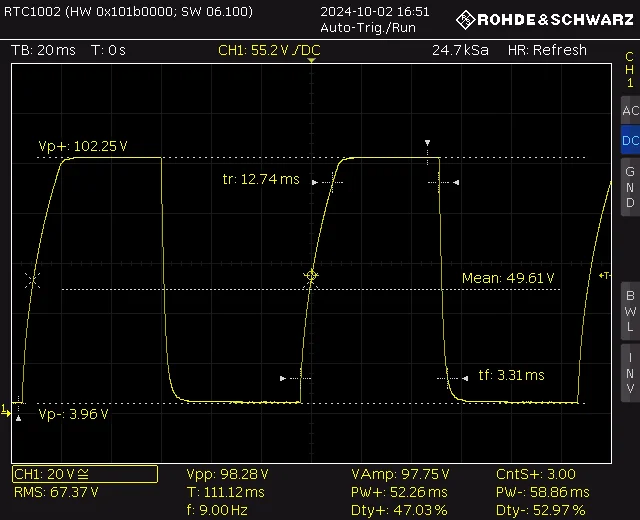
Firstly, I suspect that the acceleration of the actuator and the distance the needle is travelling may not be sufficient. The slow rise time could be preventing the rapid, sharp movements needed for jetting. Secondly, the viscosity of the solder paste could be a limiting factor. I think it might be worth trying to heat up the paste a bit to reduce its viscosity. Fortunately, I have an embedded heater that I can use for this purpose in future experiments. Another factor to consider is the relationship between the gap size (between the nozzle and the needle) and the particle size of the solder paste.
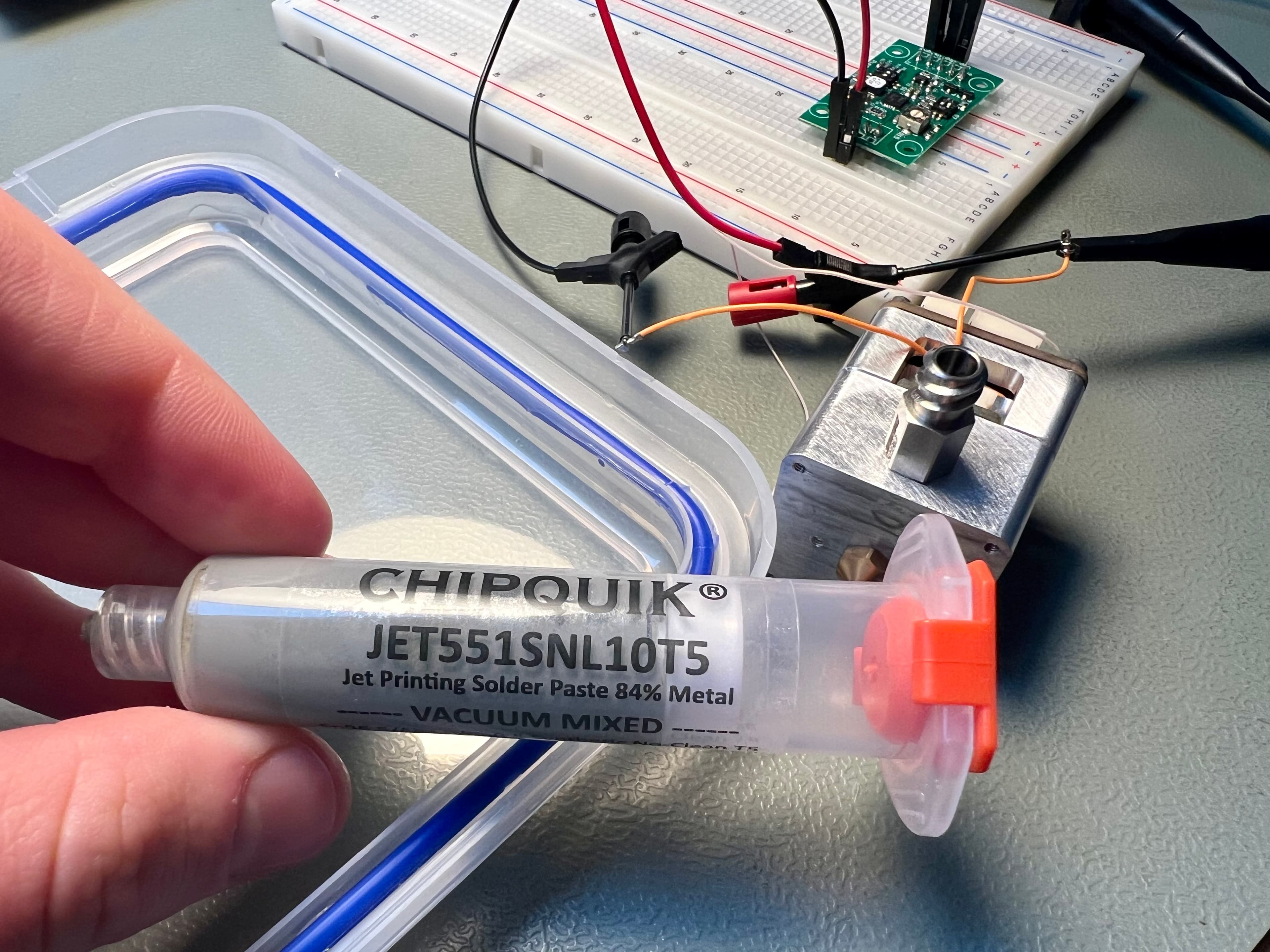
I've been using T5 paste, but switching to T7 could make a significant difference. The gap might be approximately the same size as the powder particles in the T5 paste, which could be inhibiting flow. T7 paste, with its smaller particle size, might flow more freely. Lastly, I'm starting to think that a different piezo driver might be necessary. The current setup uses a simple HV op-amp to drive a 4μF actuator, which is surprisingly effective but may not be optimal. A driver capable of producing a steeper slope, or in other words, one with higher current capability, could potentially provide the rapid acceleration needed for jetting.
Conclusions and next steps
While I haven't yet achieved my ultimate goal of jetting solder paste, this experiment has provided valuable insights and serves as a proof of concept for the mechanics of my system. I'm quite satisfied with the progress, but there's clearly more work to be done. Moving forward, my next steps will include:
- Testing with new T7 solder paste to see if the smaller particle size improves flow.
- Exploring different piezo drivers with higher current capabilities to achieve faster actuation.
- Implementing and testing paste heating to reduce viscosity and potentially improve jetting performance.
Let's clean up the needle until I get everything delivered for the next experiment.
